

Asian Hornet: Understanding the Threat and Protecting Our Environment Long-Term
The Asian hornet, which arrived in France in the early 2000s, is now disrupting our ecosystems.
Its rapid spread endangers bees, pollination, and biodiversity.
To face this threat, understanding the differences between the European hornet and its Asian counterpart is essential for taking action, reporting nests effectively, and preserving our environment.
There are several solutions to reduce this threat, which we outline further down on this page. However, 85% of hornet nests are never detected by humans because they are often hidden high in tall trees.
This is why the company Cominthesky introduced an innovative new technology in 2025, capable of scanning 100 to 200 hectares per day to determine whether hornet nests are present, how many there are, and where they are precisely located.
To achieve this, they combined custom drone technology with a high-precision thermal camera, a powerful onboard computer, AI specifically designed to detect hornet nests, and a web app that displays their geolocation.
Asian Hornet vs. European Hornet: How to Tell Them Apart and Take Action
Correctly identifying the Asian hornet is essential for responding effectively and avoiding confusion with the European hornet, a local species beneficial to our ecosystems.
Thanks to careful observation of their morphology, color, and behavior, it is possible not to confuse the two species and act appropriately.
The European Hornet: A Discreet Ally of Nature
The European hornet, present in France for centuries, is often wrongly feared due to its impressive size.
In reality, it is a useful insect that contributes to ecological balance.
It naturally regulates populations of harmful insects such as flies, wasps, and caterpillars.
It does not attack bees and poses no danger to biodiversity.
It supports the stability of forest and agricultural ecosystems.
According to the National Museum of Natural History, its ecological role is positive and contributes to preserving local biodiversity.
Physically, it can be recognized by its bright yellow abdomen with black bands, reddish head, and brown legs.
Its size can reach up to 3.5 cm for the queen, making it the largest hornet in Europe.
The Asian Hornet: A Formidable Invader
Originally from Southeast Asia, the Asian hornet was accidentally introduced into France in 2004.
Since then, it has spread across almost the entire country thanks to its high adaptability and rapid reproduction.
Today, it is classified as:
an invasive exotic species,
a Category 2 health hazard for honeybees, according to INRAE and French government agencies.
How to recognize it:
Overall darker and smaller body compared to the European hornet
Black thorax, brown abdominal segments with yellow edges, and a distinctive orange fourth segment
Yellow-tipped legs (the most visible trait)
Black head with an orange face
Average size: 2.5 to 3 cm
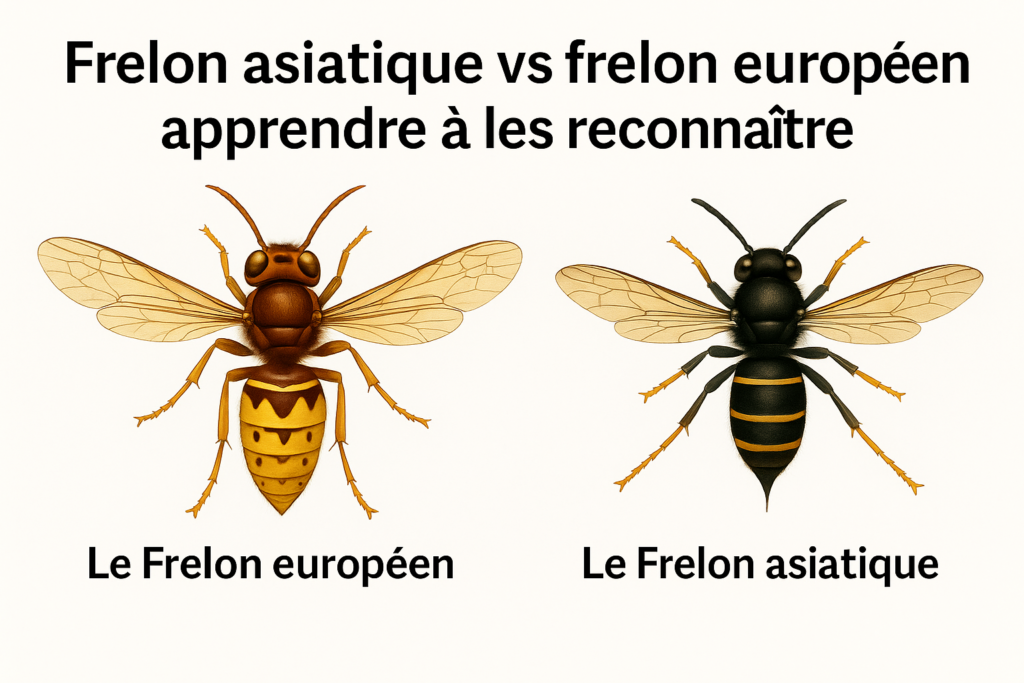
Asian hornets build large nests, often high in trees or under roofs, containing up to several thousand individuals.
The Auvergne-Rhône-Alpes region remains the most heavily infested, but the species continues to expand north and west, including into Île-de-France during warm seasons.
A Rapid Expansion Across France
Since the discovery of the first nest in 2004 in Lot-et-Garonne, the Asian hornet (Vespa velutina nigrithorax) has spread dramatically across mainland France.
2004–2010: firmly established in the Southwest, benefiting from mild winters and the absence of predators.
From 2011: spread to the Centre and Southeast, colonizing forests, orchards, and peri-urban areas.
Around 2015: most French departments were affected, including coastal and mountainous regions.
Since 2020: its presence has been confirmed throughout nearly all of France, with high density in Nouvelle-Aquitaine, Occitanie, Auvergne-Rhône-Alpes, and Île-de-France.
According to the MNHN and the National Inventory of Natural Heritage (INPN), the Asian hornet is now one of the most closely monitored invasive species in the country.
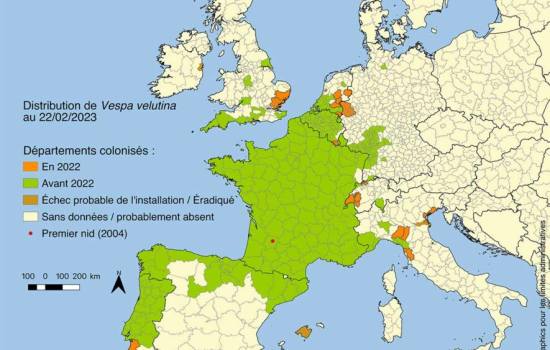
Colonization Driven by Climate and Environment
The Asian hornet easily adapts to various environments: forests, urban areas, orchards, gardens, and even building façades.
Climate change favors its expansion northward and prolongs its active season into autumn.
Each nest can produce up to 5,000 individuals and more than 200 founding queens, ensuring the creation of new colonies every spring.
Experts from MNHN estimate that it is now present in more than 95% of French departments, with particularly high densities in the Southwest.
As a result, protecting apiaries and detecting nests early have become crucial priorities.
How to Protect Your Hives from the Asian Hornet
Best Practices in the Apiary
Defending your hives starts with simple, effective, and biodiversity-friendly actions:
Reduce the hive entrance using a grid or guard screen to help bees repel hovering hornets.
Place a visual barrier (hedge, net, or panel) 1 to 2 meters from the entrance to disrupt the hornet’s attack flight.
Install selective traps away from the apiary to capture Asian hornets without harming beneficial insects.
Monitor activity around your hives regularly, especially from August to October, the peak season for hornet attacks.
These simple measures can reduce hornet pressure by up to 60%, according to several beekeeping associations.
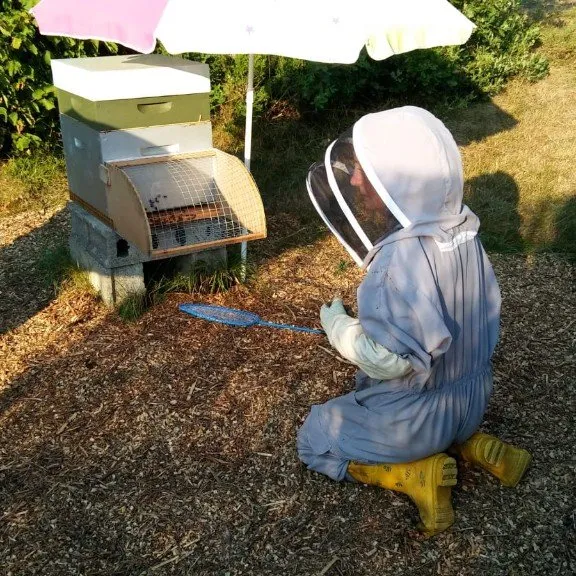
The Cominthesky Solution: Drone-Based Intervention
To effectively combat the spread of nests, Cominthesky uses drones to monitor large areas.
Equipped with high-precision thermal cameras and dedicated artificial intelligence, the drones detect nests that are often invisible to the naked eye, even high in trees.
Once detected, the nests are geolocated in a web app, then destroyed by certified operators—without chemicals and with full respect for the environment.
A Major Ecological Threat to Bees and Biodiversity
A Predator Targeting Bees
The Asian hornet feeds mainly on insects, but it particularly targets bees, capturing them at hive entrances.
This constant pressure causes severe stress within colonies, reducing foraging activity and honey production.
INRAE estimates that a single hornet colony can consume up to11 kg of insects per season, a large portion of which are bees.
Consequences for the Entire Ecosystem
Bees play an essential role in pollinating plants, crops, and fruit trees.
By reducing their numbers, the Asian hornet triggers a domino effect:
decreased fertilization of plants,
decline of melliferous plants,
disruption of local food webs.
Thus, far beyond apiaries, the entire ecological balance is threatened.
Nest Detection: A Critical Step to Slow the Spread
Asian hornet nests are often located very high in trees or hidden under rooftops.
They can reach 80 cm in diameter and contain thousands of individuals.
According to government agencies, the vast majority of these nests are never detected before winter.
Some local estimates suggest up to 85% of nests go unnoticed, although no national data confirms this yet.
INRAE reminds us that destroying nests as early as possible in the season is the most effective method to limit propagation.
Homemade traps can work well if installed early in spring, when queens begin founding their nests.
However, this strategy relies heavily on the ability to locate nests before autumn reproduction, because each untouched nest releases several founding queens that will create new colonies the following spring.
How to React When You Spot a Suspect Nest
What You Must Never Do
Never approach or attempt to destroy a nest yourself: hornets defend the colony in groups, and their stings can be dangerous and extremely painful.
Avoid vibrations or loud noises nearby, which may provoke an attack.
Do not use unauthorized chemicals, which are harmful to wildlife and ineffective long-term.
Recommended Safe Actions
Observe from a distance and note the nest’s location (height, structure, surroundings).
Take a photo if it can be done safely.
Report the nest quickly to your local council or a certified professional.
Authorities emphasize that only licensed operators can ensure safety and protect biodiversity.
In this effort, Cominthesky works alongside municipalities, local authorities, beekeepers, and individuals through innovative and environmentally friendly solutions to detect Asian hornet nests (its main innovation) and eliminate them efficiently.
The Asian hornet is not just a pest—it is a symbol of the imbalance between human activity and nature.
By reporting, preventing, and raising awareness, everyone can help slow its spread.
Collective action—citizens, beekeepers, municipalities, and companies—is the key to long-term ecological balance.
Every detected nest is a step closer to protecting bees and preserving our environment.
References of our drone experts


