
Processionary caterpillars
Here, we will cover information about the processionary caterpillar, a scourge that is growing every year in France and Europe due to the warming climate. Their highly urticating hairs are released into the air; if they touch you, they cause unsightly red patches that require prompt treatment and usually 3 weeks of antibiotics. If it is a child, it may require a trip to the emergency room, and if it is an animal, an emergency visit to the veterinarian.
There are many solutions for managing this problem, but according to INRAE, none have been sufficiently effective to date. We have innovated (once again) by creating a drone system to treat processionary caterpillar cocoons, which is highly effective, provides immediate results, and is 100% eco-friendly. To start, here is everything you need to know about this insect.

The different types of processionary caterpillars
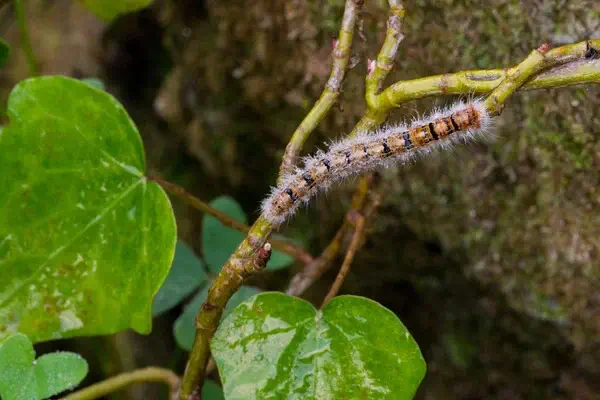
Processionary caterpillars are moth larvae belonging to the genus Thaumetopoea. Their name comes from their typical behavior: when they move, they form a single file or procession. Two species are present in France: the oak processionary caterpillar and the pine processionary caterpillar. The latter are easily recognizable by their brown, hairy bodies and the silky cocoons they build on the trees they colonize. Their life cycle lasts an entire year from the hatching of the eggs to the metamorphosis into a moth.
Oak processionary caterpillars.
The oak processionary caterpillar (Thaumetopoea processionea) is a species that develops exclusively on oak trees. It can be identified by its dark gray body with lighter lines and its very fine white hairs. It forms large, silky cocoons on trunks and large branches, often visible from late spring onwards. The cycle begins in summer, when females lay eggs at the top of trees. The larvae hatch the following spring and go through several stages of development (5 to 6 molts). During the day, they remain grouped in the cocoon, and come out at night to feed on the leaves. Once mature, they leave the tree and bury themselves in the ground to transform into pupae, then into moths at the end of summer.
Pine processionary caterpillars.
The pine processionary caterpillar (Thaumetopoea pityocampa) is a species typical of southern regions, found in the southern three-quarters of France, and has a particular fondness for pine and cedar trees. It is easily recognizable by its orange-brown body and rings of light-colored hairs. The cycle begins at the end of summer, when the adult moth lays its eggs on pine needles. The eggs hatch in the autumn, and the young caterpillars begin feeding immediately. They build a white, silky cocoon in the treetops, which serves as their shelter during the winter. They continue to develop slowly throughout this season. In early spring, they leave their cocoon in a procession to bury themselves in the ground, where they transform into pupae.
Problems caused by processionary caterpillars
Processionary caterpillars cause numerous health and environmental problems, which in the long term also result in significant economic losses due to the damage they inflict and the decline in tourism in certain regions.
The health issues caused by processionary caterpillars.
The health risk to humans and animals is primarily caused by the caterpillar's microscopic urticating hairs, which are released into the air and contain a toxin (thaumetopoein) that triggers severe allergic reactions. In humans, this ranges from simple itching to conjunctivitis or respiratory issues, which can be serious for children. For animals, especially dogs, it can lead to necrosis in the mouth or even death. This creates a significant risk in colonized areas, often forcing town halls to close parks and schools, or preventing individuals from visiting affected areas.
The environmental impact of the expansion of processionary caterpillars.
The environmental problem stems from how the caterpillars feed. By consuming needles or leaves, they cause massive defoliation of pine and oak trees. Weakened trees become more susceptible to disease, wood-boring insect attacks, and drought. In the long term, this can compromise forest growth or simply destroy gardens. In Corsica, for example, several forests have been decimated by these caterpillars, which has severe consequences for local flora and fauna.
The evolution of processionary caterpillars in the context of global warming.
For several years, the population of processionary caterpillars has been rising sharply across Europe. This increase is partly due to global warming, which promotes egg-laying and caterpillar development. Milder winters aid the survival of eggs and larvae, which were previously kept in check by prolonged frosts. As a result, we are seeing the caterpillar, once confined to the south of the Loire, now present in the Hauts-de-France, the Île-de-France, and even Belgium. This expansion is also facilitated by their rapid reproduction rate and the massive planting of coniferous forests. According to INRAE, processionary caterpillars are moving north by an average of 5 to 10 km each year. The current situation is increasingly concerning, and their presence will continue to spread, making monitoring and control essential. In fact, since April 2022, pine processionary caterpillars have been officially classified as a "species whose proliferation is harmful to human health" under Decree No. 2022-686 of April 25, 2022.
85 French departments and thousands of municipalities are already affected.

Solutions for processionary caterpillars
Traditional solutions
Traditionally, there are several methods of varying effectiveness, but none are truly comprehensive against processionary caterpillars. The first is manual removal, which involves cutting down and burning nests in trees using poles or by climbing. While fairly effective, it is only viable for accessible, low-hanging nests and remains dangerous and time-consuming. The second technique involves setting up pheromone traps to attract male moths or using collars to capture caterpillars as they descend. This method is not instantaneous, is only partially effective, and is limited to areas with low infestation. Finally, there are biological treatments like BTK, which have the drawback of being effective only under specific weather conditions and are unsuitable for populated areas due to the toxicity of the product.

Our effective drone-based solution for treating processionary caterpillar nests
For several years, we have offered an effective drone-based solution that does more than just spray a product; it targets the nest to destroy it efficiently, eliminating all caterpillars inside almost instantly. This solution guarantees maximum effectiveness in any location, providing a rapid (near-immediate) and environmentally safe result.
This fully eco-friendly solution is connected to a web app that allows for real-time tracking of the work performed on each treated nest.
Learn more about our drone solution and our services for managing processionary caterpillars
Our drone experts' credentials




















Switch to precision ecology
Contact us to discuss your needs.
Our technical team is available to analyze your situation and provide an initial assessment.
