
The autonomous delivery drone, a proven solution since 2016
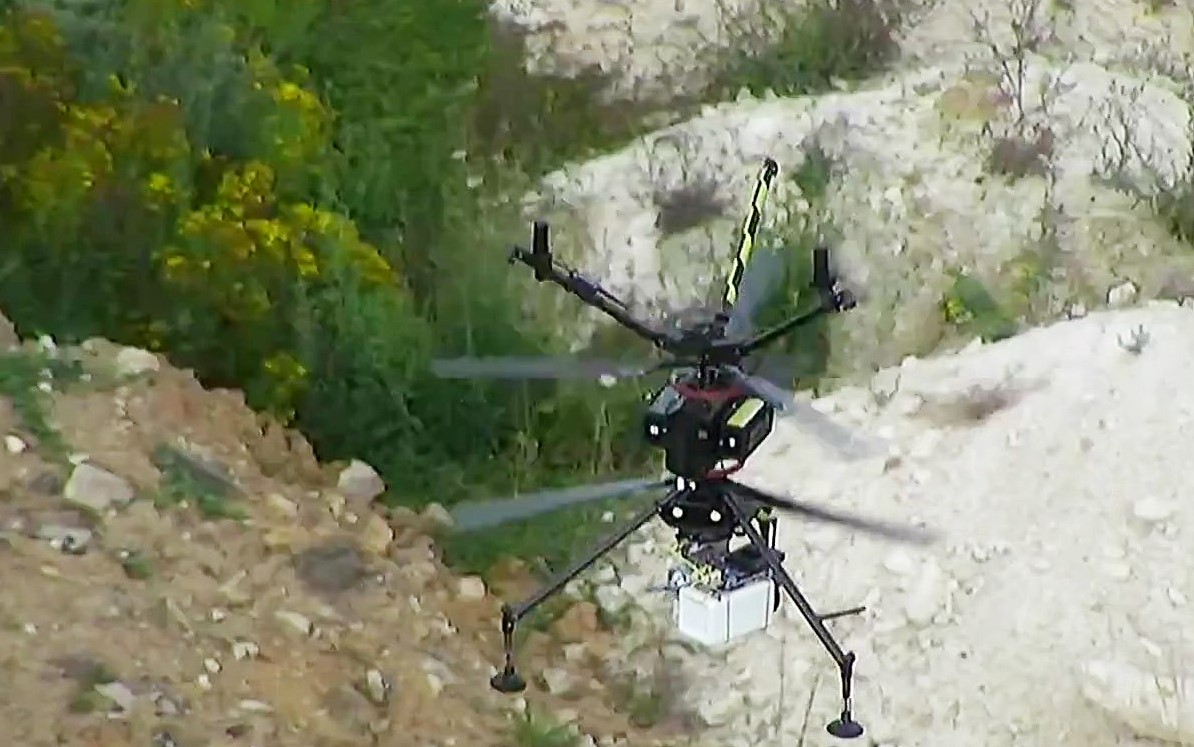
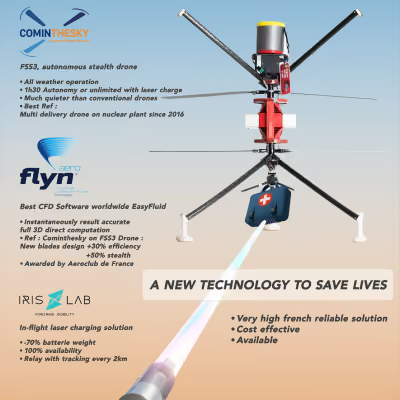
Following the serious incident at Fukushima, the French nuclear safety authority required nuclear power plants to improve their risk preparedness, particularly for those located in potentially vulnerable areas. In 2014, a call for tenders was launched, which allowed our teams to develop a new version of the Flying Sensor—a single-axis counter-rotating drone—adapted for autonomous operation, capable of performing tasks such as 4 deliveries in a single flight, all automatically and without a pilot. This was delivered in 2016, along with an annual maintenance contract that remains in effect today. Thus for the first time in the world, an autonomous rotary-wing drone was operational for drone delivery.
What is the current market for drone delivery?
The autonomous delivery drone: a future solution for "last-mile" logistics
Large-scale delivery will not be replaced immediately by alternatives like drones because it remains too complicated and too expensive. However, the drone is the ideal solution for another use, known as "the last mile," i.e., the final 5, 10, or 50 kilometers of a delivery. This is the most fragmented, slowest, and most expensive stage of the process. The use of an autonomous drone thus becomes a truly effective, faster, more ecological, and cheaper alternative.
Autonomous medical drone delivery: a priority
There are traditionally several methods that are more or less effective but never truly comprehensive against processionary caterpillars. The first is manual removal, which involves cutting and burning nests in trees using poles or by climbing. It is a fairly effective method, but only for nests that are not too high and are accessible, and it remains dangerous and time-consuming. The second technique involves setting up pheromone traps aimed at attracting male moths (traps) or capturing caterpillars as they descend (collars). This method, which is not instantaneous, is only partially effective and only in areas that are not too heavily infested. Finally, there are biological treatments like BTK, which have the disadvantage of only being usable under certain weather conditions—otherwise they are only partially effective—and in non-populated areas due to the hazardous nature of the product.
Drone delivery for remote or disaster-stricken areas
In hard-to-reach contexts such as remote areas (mountains, islands, etc.) or disaster zones, ensuring fast and low-cost deliveries and logistics becomes a real challenge. Sometimes, after a disaster for example, roads are blocked and one of the only means of access is by air (often by helicopter), which is frequently risky and very expensive. Drones offer a solution here that does not expose humans to danger, capable of flying while crossing obstacles such as a fire or a mountain and depositing a payload with precision. Even in the absence of passable road networks, the drone can deliver essential supplies, survival kits, medicine, food, or emergency equipment. It can also collect information, photos, or other data to assist rescue teams on the ground. In a simpler context, it can also deliver to isolated areas on a daily basis at a low cost.
The last-mile market today
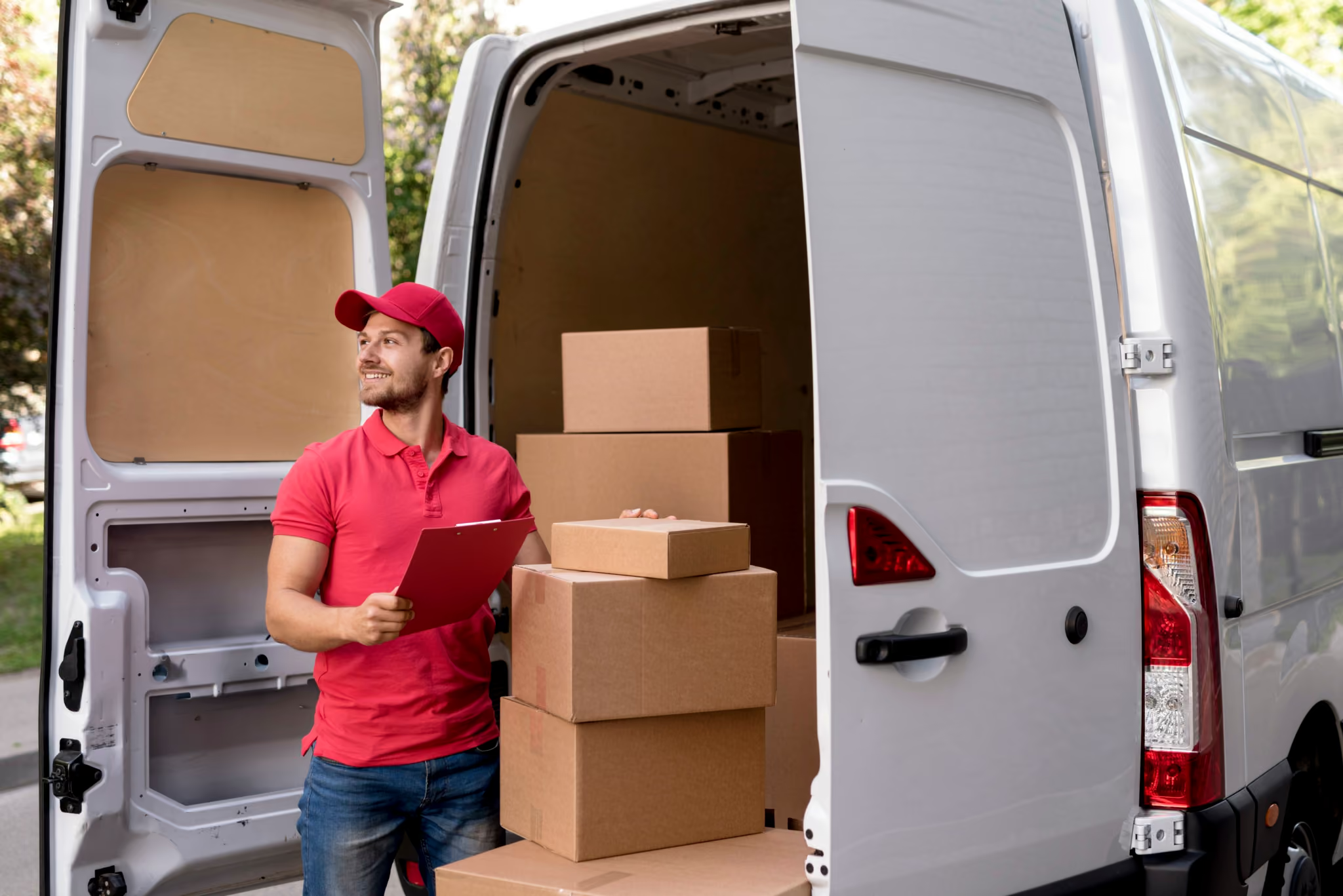
The "last mile" corresponds to the final delivery stage of the logistics journey between a production center and the end customer. Today, it is the most expensive and complex segment. It can account for up to 50% of total transport costs due to segmentation and a lack of economies of scale caused by the personalization of the destination. With the democratization of e-commerce, the demand for express home delivery has never been higher. In both urban and rural areas, companies are looking to optimize the performance of this stage while meeting environmental, economic, and reliability constraints. Indeed, 70% of consumers want fast and free delivery (McKinsey, 2022), and delivery is responsible for 10% of CO2 emissions in cities (ADEME), which increases pressure on transport to change the last-mile logistics model. This context creates fertile ground for the emergence of new logistics solutions like autonomous drones. Less polluting, faster, and capable of bypassing traffic obstacles, drones are gradually establishing themselves as an innovative response to the limitations of the traditional model.
Current experiments
The use of autonomous drones for the last mile is no longer a futuristic dream: companies have been working on the subject for several years. Often, they have started supervised tests on targeted uses, but this shows that the market is opening up and has real potential. In the United States, Amazon has been testing its Prime Air program for several years, with autonomous deliveries of light packages over short distances in semi-rural areas. In Ireland, the company Manna carries out meal deliveries by drone in partnership with fast-food chains at the neighborhood level. In Africa, countries like Rwanda and Ghana have already integrated medical drone networks to serve remote hospitals, proving that these technologies can be functional in complex environments. There is real demand and the technology is almost ready; however, it remains highly regulated for now and exists in a controlled and sometimes subsidized manner. Public actors are increasingly granting exemptions, even in Europe, to test drones for professional use in the health and industrial sectors, which is promising for the future. Nevertheless, it was indeed in France, and as early as 2016, that our team enabled the implementation of functional autonomous drone delivery—and on a nuclear power plant, no less!
Our drone delivery solution: a world first since 2016
Before the subject gained so much attention from major logistics players, our team designed and deployed a 100% operational autonomous drone delivery solution in one of the most demanding environments in the world: nuclear sites.
As early as 2016, we delivered a custom version of our Flying Sensor 3 to the Institut Laue-Langevin (Grenoble), capable of performing autonomous multi-waypoint deliveries in heavy rain and 70 km/h gusts, with a landing precision of less than 1 meter. This robust, quiet, and modular drone marked a world first: a versatile, turnkey system capable of both collecting atmospheric samples and dropping or depositing payloads on command, without human intervention, in sensitive areas.
Since then, we have improved, tested, and adapted our drone for other uses, laying the foundation for a reliable, fast, and adaptable delivery system for logistical challenges in disaster-stricken, remote, and last-mile areas.
To learn more about this proven technology and its civilian applications, explore the rest of our page dedicated to autonomous drone delivery. Progress is constant, so stay informed.
Our drone experts' credentials




















Switch to precision ecology
Contact us to discuss your requirements.
Our technical team is available to analyze your situation and provide an initial assessment.
