
Flying Sensor, also known as "FSS3"
An innovative, high-performance, and versatile drone system
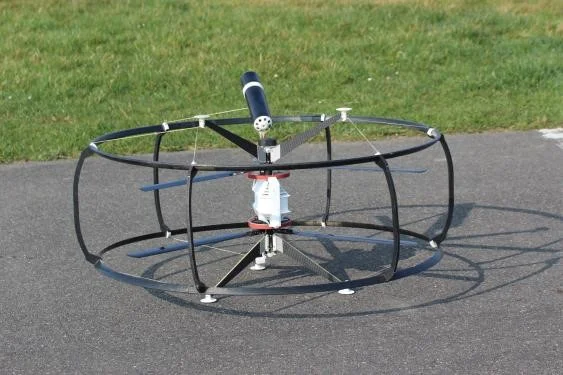
The Flying Sensor is a drone system designed in 2003 by Michel GUILHOT-GAUDEFFROY, with constant technological evolutions throughout the product's life. The core concept involves a contra-rotating dual-rotor on a single axis with the main weight at the center. A custom HMI (Human-Machine Interface), autopilot, and mechatronic design were developed in-house. This allows our team to adapt the system to the specific evolutions requested by our clients. It is 100% French-made and designed by our drone engineering office.
Flying Sensor innovations
Edouard GUILHOT-GAUDEFFROY worked extensively with his father, Michel GUILHOT-GAUDEFFROY, and various engineers specializing in professional drones to design the FSS3. This versatile drone is adapted for security, environmental, and construction challenges, and has been used for delivery since 2016. This drone has led to the holding of two international patents.
The FSS3 Flying Sensor is an aircraft designed to comply with new European regulations regarding RPAs (Remotely Piloted Aircraft). Commonly, UAVs/UAS/drones are aircraft not authorized for navigation and tasks managed by an onboard computer. Our RPA, the FSS3, is controlled in real-time by a remote operator via a triple-redundant secure wireless connection, or it can fly fully autonomously using a navigation program configured for planned flight scenarios.

Flying Sensor applications and payloads
The Flying Sensor drone can be equipped with a multitude of payloads, including various cameras for photography and video, thermal cameras for thermographic analysis, and multiple sensors. It can also carry specific payloads such as precision spraying systems, atmospheric sampling equipment, or multi-drop mechanisms for a single flight. Building inspections can be performed at close range thanks to its protective shield, with a camera mounted underneath—as is common on drones—or on top of the drone to inspect areas like the undersides of bridges. Cominthesky meets client needs by creating custom payloads tailored to their specific requirements.
Payloads can be dropped at a programmed altitude or deposited after landing. A winch can also be used. We provide services and manufacture custom drones.

Mechanical design of the Flying Sensor
The FSS3 Flying Sensor system consists of two main parts: the flight unit and the ground unit. The flight unit comprises the vehicle and all its accessories (battery packs, payloads, protection, etc.). The ground unit consists of the ground station with its control interface for interacting with the drone, and also includes a set of chargers.
The FSS3 inspection drone system operates on the principle of contra-rotation with a slow, continuous rotation speed. Compared to other operating principles (multi-rotors, tethered balloons), this allows for:
- Autonomous flight
- Excellent battery life
- Silent (stealthy), useful for delivery and security applications
- Contact flight (useful for inspection or specific security applications)
- Better resistance to turbulence (wind, etc.)
- Versatility
Flying Sensor technical specifications
- Enhanced onboard cybersecurity
- High payload capacity: 1.6 to 2 kg for a 4 kg drone
- Superior flight stability: Withstands wind gusts of 70 km/h
- Proven water resistance in heavy rain
- High responsiveness thanks to its symmetrical design. High efficiency with 1 to 1.5 hours of battery life.
- Low inertia
- Redundant communication systems
- Contact flight with carbon shield: The drone can fly while remaining in contact with a wall, sheet metal, or glass, with the camera positioned 50 cm from the target.
- Flight speed: 12 m/s minimum
- Made in France
Our drone experts' credentials




















Our drone experts' credentials
Switch to precision ecology
Contact us to discuss your requirements.
Our technical team is available to analyze your situation and provide an initial assessment.
