Gull and rook egg sterilization drone with real-time tracking
Following a request from a citizen of the town of Trouville in 2014, we designed and created the world's first drone specialized for gull egg sterilization to better regulate the gull population in city centers, safely and at a competitive price. Since 2018, our technology has been perfectly effective for our clients' needs, and they continue to renew their partnership with our drone company.
Complexity of this type of mission for managing "gull" issues
The gull: a predator with no predators of its own
In fact, apart from the falcon (you can quickly see why we chose that name for our drone), which is too rarely present, the gull—which is overpopulated and increasingly found in city centers—has no predators. This animal is protected, and it is illegal to injure them, kill them, or break their eggs. The best solution identified is egg sterilization. Usually performed by rope access technicians, there have been accidents due to the birds' aggression, and the cost of intervention is high, if only because it takes time to access the roofs at each address.
Gull characteristics
You will find plenty of general information on the « Gulls » page, but here are the essentials regarding our services:
- Intelligent birds that live for 25 years
- Group attack by dozens of individuals, causing a head injury severe enough to require an emergency room visit
- Nests on roofs, sometimes near chimneys, pipes, or antennas, and therefore in cluttered areas
- Nests by the seaside, where wind gusts are frequent
- Does not hesitate to attack drones
- Nests from April to June depending on the local climate: earlier in the Mediterranean and later in the North.
To be effective during egg sterilization, a well-honed process
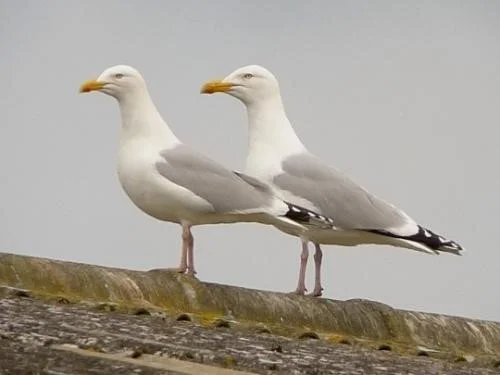
Yellow-legged and herring gulls
- It starts with properly scouting the nests and eggs. There is no point in flying everywhere and wasting time. When a town hall is unsure of nesting locations, scouting is essential. We carry this out using drones and AI for nest and egg recognition to map the presence of gull nests and their eggs, if any are already present.
- Next, mission preparation involves the right vegetable oils, a large number of batteries to fly for at least 5 to 6 hours a day, and checking the drones and payloads: The oil damages pumps and hoses.
- Possessing high-tech drones to fly with stability in windy and cluttered areas: The speed of the mission depends on this, and therefore, so do the efficiency and the final cost.
- It is necessary to visit EACH specified address AT LEAST twice, at intervals of more than 3 weeks, to prevent nesting that would add more chicks to the current population. Generally, thanks to the speed and efficiency of our pilots and drones, we make 2 passes per address, provided the nests did not already contain 3 eggs each. A nest with 1 egg usually means there will be 2 more in the following days.
- Having a pilot team experienced not only in drone flight but also in this type of delicate mission, with specific training provided by ornithologists, which is mandatory for this type of work.
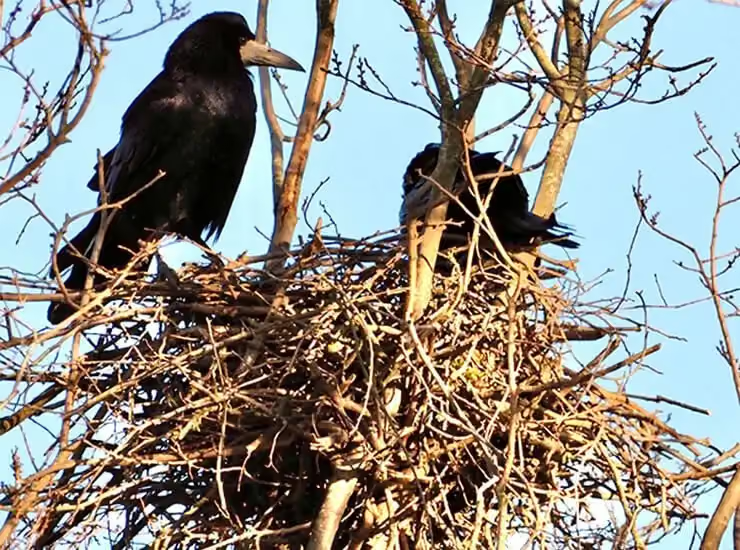
Rooks: egg sterilization with the FAUCON drone
Rooks (Corvus frugilegus) are highly social birds that live in large colonies, often established in wooded urban areas. Their presence can cause noise pollution, mess, and significant disturbance for residents.
Like gulls, they are a protected species: it is strictly forbidden to harm them, destroy their nests, or tamper with their eggs without prefectural authorization.
Drone-based rook egg sterilization is currently the most effective, discreet, and respectful method for controlling their reproduction.
Rook characteristics relevant to our operations
- Highly social species living in compact colonies
- Early nesting: February to April
- Clutch of 3 to 4 eggs per nest (sometimes 5)
- Nests located high up in large trees
- Remarkable intelligence, high adaptability
- Frequently found in parks, urban wooded areas, and agricultural sectors
Why use the FAUCON drone for rooks?
The FAUCON drone, originally designed for gulls, perfectly meets the technical requirements for this species: As with gulls, a prefectural exemption is mandatory before any intervention. Demand from local authorities is rising sharply due to genuine overpopulation issues.
- precise nest identification
- perfectly controlled application of vegetable-based sterilization oils
- optimal stability even in dense or windy environments
- rapid intervention on a large number of nests
- silent mission, minimizing stress for adult birds
Technical specifications of the FAUCON, a drone for gull egg sterilization
3 versions
- Faucon 3.1: 2.2 kg loaded with battery and product
- Faucon 3.2: 3.8 kg loaded with battery and product
- RTK drone (Centimeter-level precision with multi-satellite tracking, essential for safe and easy flight in city centers)
- Ground distance LiDAR for enhanced flight stability
- Flight time at full capacity:
- – Approx. 15 min for Faucon 3.1
- – 20 min for Faucon 3.2
- Oil canister capacity:
- – 2 nests per flight for Faucon 3.1
- – 4 nests per flight on Faucon 3.2
- Generally, you will find 1 to 2 nests per individual roof. Higher numbers are found on social housing, hospital, or factory roofs.
- Specialized oil pump
- Nozzle specifically adapted to the task
- Sufficient power to withstand wind gusts

Drone connected to an AI-powered web app
We provide access to a web application specifically designed for our clients and pilots, connected to our gull egg sterilization drones:
Generation of a dedicated website for municipalities to handle online reports from citizens, businesses, and co-ownerships: Saves significant time by reducing phone and email inquiries.
All mission information is centralized in real time.
Highly precise reporting maps
Real-time mission progress tracking via dashboard or map view
Automatic notifications sent to citizens and businesses upon request, featuring photos of sterilized eggs and empty nests by gull species
Optional: Billing management for specific client types
Real-time online statistics with comparison tools
AI-powered egg and chick counting
Data filters and numerous features designed for pilots
Municipalities retain full ownership of their data, which is never used by our drone company outside of mission requirements.
Switch to precision ecology
Contact us to discuss your needs.
Our technical team is available to analyze your situation and provide an initial assessment.

Our drone experts' credentials